Lost Cabin
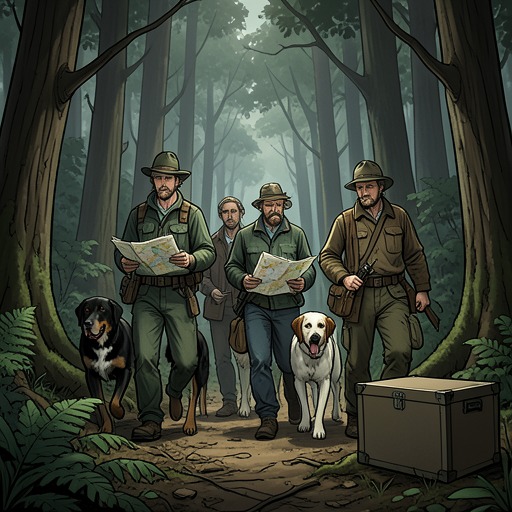
The Call of the WildLost Cabin is a legendary, never fully located site whose mystery propels John Thornton, Pete, Hans, Buck, and their other dogs into the eastern wilderness. The search begins as an expedition after Buck’s remarkable sled pull enables John Thornton to clear debts, and it ends not with the cabin but with a rich placer whose gold transforms the journey’s practical outcome. At the same time, the Lost Cabin quest carries Buck away from settled routes and human purposes toward the wild life that finally claims him.
Legend and Motivation
The Lost Cabin is known through an old and tragic tradition rather than through reliable firsthand knowledge. Its history is said to be as old as the history of the country, and many men have searched for it: few found anything, while more than a few never returned. No one knows who first built the ancient, ramshackle cabin. The oldest tradition already stops short of identifying that original man, leaving the site surrounded by incomplete testimony and inherited mystery.
Dying men had sworn that the cabin marked the position of a lost mine, supporting their claims with nuggets unlike any known grade of gold in the Northland. Yet no living man had looted this supposed treasure house, and the dead could no longer clarify their accounts. The Lost Cabin therefore functions as both a material promise and a narrative absence: its authority rests on traces, rumors, and gold fragments, while its precise location remains unavailable.
The Search Through the Interior
John Thornton and his partners face east with Buck and half a dozen other dogs, accepting an unknown trail on which men and dogs as capable as themselves have already failed. They sled seventy miles up the Yukon River, turn into the Stewart River, pass the Mayo and McQuestion, and continue until the Stewart narrows into a stream threading the peaks that form the backbone of the continent. The journey leaves behind the established transportation world associated with dispatches, packed trails, and government routes.
The expedition advances without haste or a fixed timetable. John Thornton asks little of either human society or nature; with salt and a rifle, he can enter the wilderness and live there as long as necessary. Hunting supplies the daily food when successful, while ammunition and tools form the principal load. For Buck, the journey is a delight because it combines hunting, fishing, and indefinite movement through unfamiliar country rather than the repetitive labor of a mail team.
The search proceeds in alternating stretches of travel and camp. For weeks the party moves steadily; for other weeks the dogs loaf while the men burn through frozen muck and gravel and wash pans of dirt by the fire. Sometimes they go hungry, and sometimes they feast according to the luck of the hunt. In summer, men and dogs cross blue mountain lakes by raft and travel unknown rivers in slender boats made from trees cut and sawn in the forest.
The landscape repeatedly offers signs of an earlier human presence without explaining them. The party crosses divides in summer blizzards, shivers beneath the midnight sun on mountains above the timber line, descends into valleys thick with insects, and later enters a silent lake country where ice forms along sheltered shores. During another winter, they follow trails nearly erased by time. An ancient path blazed through the forest seems to promise that the Lost Cabin is near, but it begins nowhere and ends nowhere, preserving the mystery of both its maker and its purpose.
A second relic deepens rather than resolves the enigma. The travelers find the time-worn wreckage of a hunting lodge, and among rotted blankets John Thornton discovers a long-barreled flintlock. He identifies it as a Hudson Bay Company gun from the early Northwest period, when such a weapon was worth its weight in beaver skins packed flat. The gun provides a tangible link to an earlier frontier, but no clue identifies the person who built the lodge or abandoned the weapon.
Discovery and Material Reward
The search finally produces a discovery, but not the object named by the legend. In spring, after all the wandering, the party finds a shallow placer in a broad valley where gold shows like yellow butter across the bottom of the washing pan. They stop searching for the Lost Cabin because the placer is sufficient. The legendary destination has yielded to a real and accessible source of wealth.
The discovery turns the expedition into sustained labor. Each day earns thousands of dollars in clean dust and nuggets, which are packed into moosehide bags weighing fifty pounds apiece and stacked outside the spruce-bough lodge like firewood. The scale of the accumulation makes the wilderness temporarily resemble a workplace and a storehouse, yet the wealth does not restore the earlier human order. It simply gives the travelers the means to remain in the interior and continue living beyond ordinary schedules.
The placer also changes Buck’s immediate role. There is little for the dogs to do except haul meat from animals John Thornton kills, so Buck spends long hours by the fire. The reduced demand for his labor creates room for his memories and instincts to surface. The expedition, begun as a search for a mine attached to a cabin, thus becomes the setting in which Buck’s inward movement toward an ancestral and nonhuman world accelerates.
Wilderness Threshold and Afterlife
The Lost Cabin expedition carries the party into a region where human routes are fragmentary and where animal movement increasingly determines the rhythm of events. The search follows old paths, abandoned structures, rivers, seasonal changes, and migrating game rather than a settled road. Its geography connects the gold economy to a landscape that resists complete possession: the party can extract wealth from the placer, but it cannot fully explain the traces of those who came before or master the surrounding wilderness.
That tension becomes decisive after the Yeehats attack the camp. Hans is found dead with arrows in his body, and the spruce-bough lodge has been wrecked; John Thornton is dead as well. Buck responds by destroying the attackers, but once John Thornton is gone, the last tie binding him to human claims is broken. The wolf pack then enters the valley, and Buck fights his way into its acceptance before running beside the wild brother.
The valley associated with the expedition becomes the center of Buck’s later legend. The Yeehats report a Ghost Dog leading a changed breed of timber wolves, stealing from camps, robbing traps, killing dogs, and defying their hunters. They avoid one particular valley, where hunters disappear and others are found with slashed throats and oversized wolf tracks in the snow. In summer, however, a great wolf returns alone to the valley, where yellow contents from rotted moosehide sacks have sunk into the ground beneath grass and mold. He pauses there, howls once mournfully, and departs. The Lost Cabin itself remains unfound, but its surrounding wilderness becomes the place where human memory, abandoned wealth, violence, and Buck’s new life converge.